Routing Instance
This article is based on Juniper Networks. A routing instance is a collection of routing-tables, interfaces, and routing protocol parameters. A single routing instance may have numerous routing tables, such as unicast IPv4, unicast IPv6, and multicast IPv4 routing tables. Inet.0 and inet6.0 are the default instance. inet.0 also called by master. There are13 types of routing instances:
- Ethernet VPN (EVPN) : Connect customer sites using layer 2 virtual bridge. But, this instance type only applied to MX Series
- Forwarding: here is no mapping between interface to instance. Because, all interface belong to default instance inet.0 using forwarding as type.
- Internet Multicast over MPLS: This instance offers an ingress replication tunnel for MPLS cloud-based MPBGP or MVPN IP Multicast traffic between routers.
- Layer 2 Backhaul VPN: when using this instance type, router learn both the outer and inner tag of incoming packets. when instance-role statement using access, or the outer VLAN tag only when instance-role statement using NNI. But, this type only applied to MX Series
- Layer 2-control: Used for customer edge interface that using RSTP or MTSP of VPLS. Can not be used when customer edge interface facing multihomed to Provider Edge interfaces, incase please use default BPDU tunneling. But, this instance type only applied to MX Series
- Layer 2 VPN: this type used for layer 2 virtual private network (VPN).
- MAC-VRF:instance that used to configure multiple customer-specific EVPN instances (EVIs) of type MAC-VRF each of can support a different EVPN service type. This configuration results in customer-specific VRF tables with MAC addresses on each Juniper Networks device that serves as a virtual tunnel endpoint (VTEP) in the EVPN-VXLAN network.
- MPLS Forwarding: Protection against label spoofing across ASBRs.
- Non forwarding: All routes are installed into default forwarding table.
- Virtual Router: This same like VPN VRF, but used for non-VPN. So, there will be no and VRF import, VRF Export, or Route Distinguisher.
- Virtual Switch: use to isolate LAN segment with Spanning Tree Protocol, by using VLAN ID. But, this type only applied to MX Series
- VPLS: Used to support point-to-multipoint between sited of sites in VPN.
- VRF: VPN Routing and Forwarding (VRF) instance type for Layer 3 VPN implementation. Each VRF is corresponding with forwarding table.
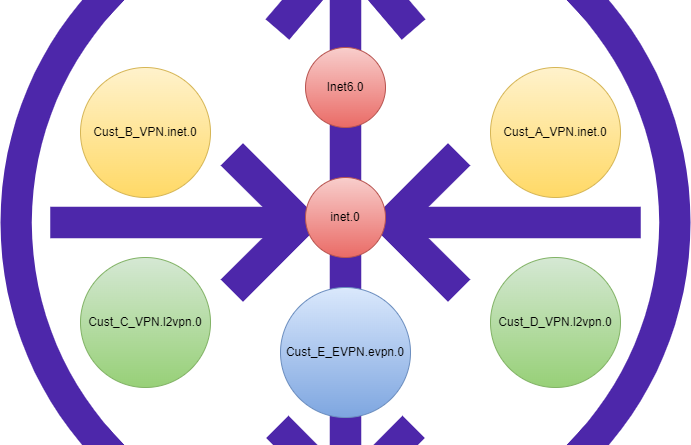
Multiple instance of BGP, OSPF, and RIP using Layer 3 VPN implementation. So they keep separate routing information for different VPN for advertise and received routing. Routing instance also used for internal communication between component. The illustration below shows a routing instance:
