OSPF Fundamentals
OSPF is one of dynamic routing protocol which is interior gateway protocol (IGP) which support VLSM, classless routing, summarisation, authentication, and also IPv4 that covered by OSPFv3. Protocol number 89, assigned by IANA, is used with multicast addresses for communication between SPF and DR routers in OSPF. OSPF using Dijkstra Shortest Path First (SPF) algorithm to build no loop network topology. Every change in the network will trigger SPF recalculation to define new topology. Each router will act as root of the SPF tree (SPT), SPT contains all destination within the OSPF domain. Each OSPF router in one OSPF domain will have different SPT but the LSDB that used for calculating the SPT is identical.
OSPF advertise link state advertisement (LSA) containing link state, metric to neighbour routers. Routers receive LSAs, store them in the LSDB, and then advertise the LSDB to their neighbors. LSDB will contain all the links in area, but SPT only shows the shortest path to network destination. OSP use hierarchical which are backbone and non-backbone areas. Non-backbone areas use the backbone area (area 0) to communicate with each other, as it provides transit connectivity. Non-backbone area is area that not belong to area 0. There are 5 packet that used by OSPF that is Hello, Database description, Link-state request (LSR), Link-state Update (LSU), and Link-state ack.
OSPF use Hello Packets to discover and maintain neighbours. Some of data that exist in hello packet are Router ID, Authentication Options, Area ID, Interface Address Mask, Interface Priority, Hello Interval, Dead Interval, Designated Router & Backup DR, Active Neighbour. Router ID is a unique identity for each router in OSPF domain. Please follow ospf configuration in the next post.
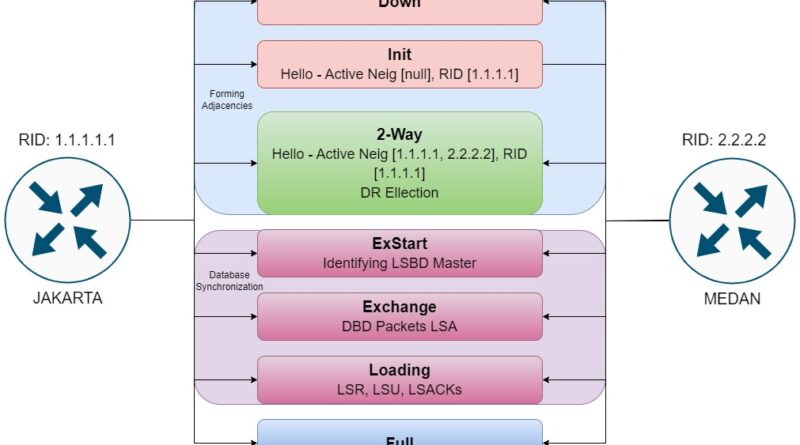
OSPF Neighbour States
Down = Down are initial states that means router not receiving OSPF Hello Packets yet.
Attempt = This state indicates no recent packet that received but router still attempting communication
Init = Hello packet already received but bidirectional still not established
2-Way = When DR/BDR needed the election process happened during this states
ExStart = LSDB synchronization
Exhange = Routers exchange the link states via DBD packtes
Loading = In the Loading state, the router sends LSR packets to neighbors and waits for the missing LSAs not received during Exchange
Full = Neighbouring is fully adjacent
